
Our approach
Everything we do is evidence-informed, student-centred and aligned with the Ontario curriculum.
On this page:
About Ontario’s approach to school mental health
- Ontario has a comprehensive and systematic multi-year School Mental Health and Addictions Strategy that follows scientific research and responds to student needs and service trends.
- Each school board across the province has a mental health leadership team that uses this provincial strategy to guide the development of their local School Mental Health and Addictions Strategy, that reflects the needs, context, strengths and resources of their community.
- Every school board has an implementation support coach from School Mental Health Ontario to help them roll out their strategy.
- School boards across the province have access to a range of evidence-informed, identity-affirming programming, resources, professional learning and training to support excellence in school mental health service delivery. This suite of supports is routinely updated as new identity-
- Ontario educators, school/system leaders, student support staff, school mental health professionals, and students themselves are involved in the development of mental health resources, learning, and programming used in Ontario schools.
Ontario’s multi-tiered system of support for school mental health
Across the globe, a multi-tiered system of support approach is seen as foundational for school mental health service delivery. This structure helps to establish priorities, clarify roles, and ensure service coordination and quality within a complex and evolving field. Broadly, it includes a continuum of services: mental health promotion, early identification, prevention and early intervention, and service pathways / clinical support for more intensive mental health needs.
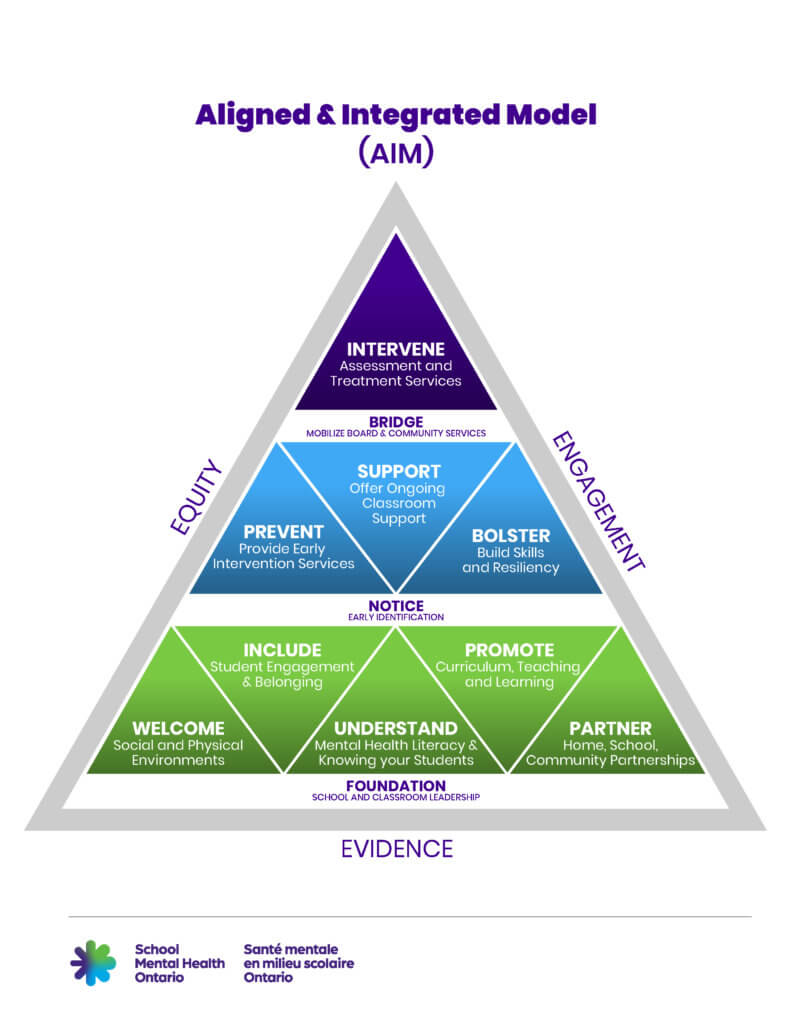
The Aligned and Integrated Model or AIM is a triangle with three equal sides that shows the three levels of student mental health support in Ontario. The bottom of the triangle is the Foundation and includes school and classroom leadership. It’s divided into the following five sections:
Welcome – school and classroom physical environments
Include – student engagement and belonging
Understand – Mental health literacy and knowing your students
Promote – Curriculum, teaching and learning
Partner – Home, school, community partnerships
The second level is Notice and represents early identification. It’s divided into the following three segments:
Prevent – Provide early intervention services
Support – Offer ongoing classroom support
Bolster – Build skills and resiliency
The third level is the top of the triangle. It is Bridge and represents mobilizing board and community supports. It includes one segment:
Intervene – Assessment and treatment services The words equity, engagement and evidence appear around the graphic.
Tier one
A multi-tiered system of support approach begins with and prioritizes mental health promotion, highlighting the critical role that schools play in everyday wellness and to enhance student mental health literacy and leadership. This is often referred to as tier one support and is universally offered at the school and classroom level.
Educators, in particular, have tremendous opportunity to strengthen wellness as part of everyday practice, and to notice and support when students show signs of a mental health problem. Consistent, high-quality educator mental health literacy is a foundational part of the multi-tiered system of support approach at tier one. School and system leaders have a key role in creating the conditions for effective student mental health promotion.
Although classroom educators are often the first to note a change in emotions or behaviour that might signal a mental health disorder, any member of the school staff could be the one that a student chooses to connect with for emotional support. As a result, all school staff need some level of mental health awareness, and some, particularly those who support students in a special capacity (e.g., child and youth worker, coach, guidance teacher, special educator, GSA leader, grad coach) can benefit from specialized mental health literacy focused on early identification and support. In addition to learning how to recognize signs of a mental health problem, in a multi-tiered system of support model, student support staff are equipped with identity-affirming resources, tools, and programming that can be used to help students who might benefit from additional support and allyship.
Tier two
When students are showing signs of an emerging or escalating mental health problem, tier two school-based prevention and early intervention services can be introduced. In Ontario, school mental health professionals who are registered with a professional college, such as school social workers and psychologists/psychological associates, are available to provide brief, evidence-informed interventions to help students with mild-to-moderate mental health problems.
Tier three
Some students with significant, acute, or complex mental health needs require more intensive or urgent mental health services, referred to as tier three or tier four support. In these cases, school mental health professionals help with service pathways and clinical support. The collaborative vision for the system of care outlined in Right Time, Right Care highlights the critical need for clear and seamless transitions to, from, and through more intensive or specialized services when Ontario students require this level of support.
School mental health professionals can assist with these transitions, supporting students and their families with access, navigation, and care plans. When students are unable or unwilling to receive these services within community mental health, cultural/faith, or hospital settings, assessment and intervention is provided by school mental health professionals.
School Mental Health Strategy
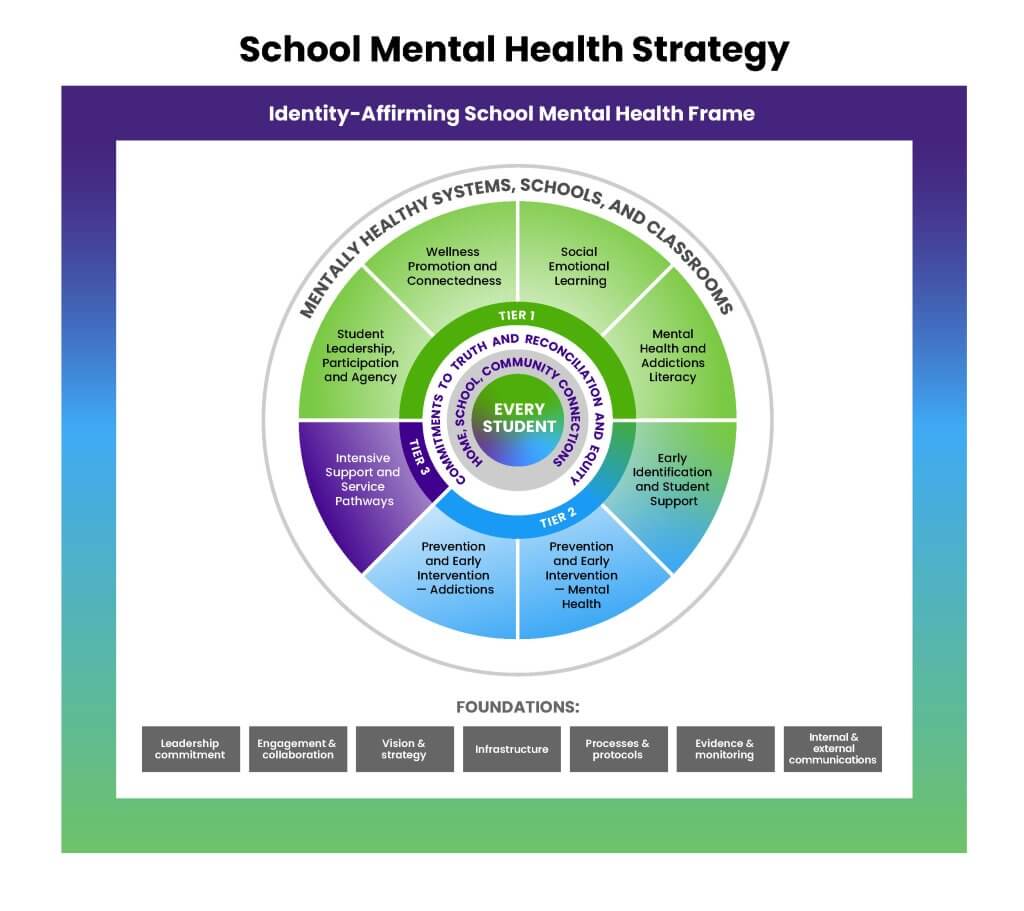
The School Mental Health and Addictions Strategy is visually depicted in the wheel graphic below. It follows the multi-tiered system of support approach, with tier one supports noted in green, tier two supports in blue, and tier three supports in purple. The school mental health supports and services included in the strategy are meant to wrap around every student, as noted in the centre of the figure. Also at the centre, noting the primacy of its importance, is a focus on home, school, and community connections, and commitments to Truth and Reconciliation and equity. the intersection of equity, identity, and student mental health.
This infographic presents the key components of Ontario’s comprehensive, evidence-informed School Mental Health Strategy. The strategy supports mentally healthy schools and classrooms across Ontario through a multi-tiered system of support that serves every student.
Framing the strategy is the Identity-Affirming School Mental Health Frame, which centres commitments to Truth and Reconciliation and equity, acknowledges systemic inequities, and promotes differentiated approaches that affirm students’ unique and intersecting identities.
The Foundations of the strategy include: leadership commitment, engagement and collaboration, infrastructure, vision and strategy, processes and protocols, evidence and monitoring, and internal and external communication. These foundations are reflected along the bottom of the visual. They represent the conditions that support scalable, sustainable, and high-impact mental health practices across the province
The strategy visual is depicted as a circle with multiple layers. The first and outer layer says “Mentally Healthy Systems, Schools and Classrooms”. The next layer displays areas of support across the three tiers of support:
Tier one includes:
- Student leadership, participation and agency, Wellness promotion and connectedness, Social emotional learning, Mental health and addictions literacy
Tier two includes:
- Prevention and early intervention – mental health, and Prevention and early intervention – addictions
Tier three includes:
- Intensive supports and service pathways
Towards the centre of the strategy visual is commitments to Truth and Reconciliation and equity,and strong home, school, and community connections with Every Student at the core; supporting the vision that every student has access to differentiated and responsive, identity-affirming and evidence-informed mental health promotion, prevention and intervention services at school.
Centring every student
Every student
At the centre of the strategy is every student, and their unique strengths, identities, needs and natural supports. The strategy considers the whole child, as well as their family and community and experiences. Putting a focus on every student, rather than “all students” encourages strong consideration of each student’s unique identity when planning relevant mental health supports and services.
Home, school and community connections
Students have a range of natural supports and protective influences in their lives, at home, school, and in their communities. Working together, the strength of these natural supports can be optimized. This aspect of the strategy focuses on explicit and intentional parent, caregiver, and community connections and support, with a view to strengthen relationships, build mental health literacy, co-develop collaborative mental health promotion initiatives, and reinforce common understandings and messaging for young people.
Commitments to Truth and Reconciliation, and equity
The strategy emphasizes that school mental health supports must be grounded in commitments to Truth and Reconciliation, and equity to truly meet the needs of every student.
Tier One Mental Health Promotion
Student leadership, participation and agency
Young people have a unique perspective and powerful voice when it comes to mental health promotion and literacy at school. Students have had input on the provincial school mental health strategy, through the #HearNowON surveys and focus groups conducted over the years, as well as through their participation on provincial reference groups (ThriveSMH, Pros’pairs, Newcomer Working Group). Student leadership, participation, and agency is encouraged at the district level, with recommendations for best practices in this area summarized within the Student Engagement Toolkit. A number of student-facing resources are promoted through web and social media platforms.
Wellness Promotion and Connectedness
Strength-based wellness promotion and connectedness, as part of daily classroom practice, is a key cornerstone for best practice in school mental health support. This includes, for example, a warm welcome for every student each day to create a strong sense of belonging at school, everyday mental health practices that reinforce a sense of wellness and a range of culturally responsive ways of coping with stress, and reminders about individual gifts, strengths and the power of self-love. It also includes helping students to maintain good lifestyle habits, like healthy nutrition, good sleep hygiene, daily activity and balanced screen time. Wellness-promoting classroom resources are available to help school staff nurture student mental health as part of each school day.
Social Emotional Skill Development
Social emotional skill development at school, also sometimes called social emotional learning, is the teaching, learning, and practicing of social emotional skills in the classroom. This includes helping students to understand and manage emotions, solve problems, cope with academic and life stress, and build and maintain relationships with peers and adults. It is meant to support a child’s social emotional development, which is a lifelong process that follows predictable stages and can be enhanced through interaction and support. It is nurtured at home, at school, and in the community. “Social-emotional learning skills help students foster overall health and well-being, good mental health, and support the ability to learn and thrive” (PPM 169).
Mental health and addictions literacy
When students have accurate and current information about mental health, they gain a sense of agency for their own well-being and are better equipped to help themselves, or a peer, when mental health or substance use health problems arise. In addition, knowledgeable young people can be ambassadors for stigma reduction, as they normalize the experience of mental health distress and help-seeking. Findings from #HearNowON indicate that students want to learn about mental health at school.
#HearNowON participants also highlighted the need to ensure strong mental health literacy for educators who support this instruction. In response, the strategy focuses on greater roll-out of MH LIT for educators, guidance teachers, and special education resource teachers, and associated classroom resources, alongside implementation support for provincially mandated mental health learning modules in grades 6, 7, 8 and 10, as well as Student MH LIT secondary student mental health learning. Mental health literacy for school and system leaders is also supportive, and the strategy includes role-specific mental health literacy for principals/vice-principals and for directors and superintendents of education.
Early identification and student support
Although classroom educators are often the first to note a change for a student that might signal a need for mental health support, other student support staff often have a key role in early identification and student support (e.g., child and youth practitioner, guidance teacher, special educator, GSA leader, grad coach). The strategy includes expanded role-specific learning opportunities and resources, so that more caring adults at school can be equipped to support students with emerging or escalating mental health needs. Several class-wide and small group programs are currently being piloted in Ontario schools with student support staff, including Coping in Action, a three part evidence-informed mental health promotion program that focuses on problem solving and calming skills, Balanced Device Use, a three module program that helps middle school students to make informed decisions about their use of digital media, and Bridges, a flexible student support program for GSA leaders.
Tier two
Prevention and Early Intervention – Mental Health
School mental health professionals in Ontario schools provide prevention and early intervention services when students have mild-to-moderate mental health needs that would benefit from brief, targeted intervention. Training on brief protocols continues to be prioritized (e.g., Brief Intervention for School Clinicians, Brief Coping Interventions, Supporting Transition Resilience of Newcomer Groups), alongside ongoing support for clinical managers who oversee implementation. In collaboration with researchers at McMaster University, tools and professional learning to advance measurement-based care in relation to these protocols are provided. Training on core clinical approaches, such as Cognitive Behavioural Therapy (CBT) and Motivational Interviewing (MI), are also a key part of the strategy for encouraging quality and consistency in prevention and early intervention service delivery. Additional approaches and protocols are being piloted currently, including ACT for Schools (developed in partnership with the Toronto Centre for Compassion Focused Therapy) and Let’s Talk the Talk (a program led by CAMH AMANI Mental Health & Substance Use Program).
Prevention and Early Intervention – Addictions
Young people may require support at school for emerging or escalating problems with substance use health or other potentially addictive behaviours, like gaming, gambling, shopping, shoplifting, etc. It is important that school mental health professionals have the tools they need to recognize when students may be experiencing problems in this area, and to provide brief evidence-informed interventions when needed. Resources and training in Screening, Brief Intervention, and Referral to Treatment (SBIRT) is a strong priority in Ontario schools. In addition, evidence-informed approaches like CBT and MI, and brief-programming such as PreVenture, are being supported.
Tier three
Intensive supports and service pathways
Over the past several years, School Mental Health Ontario has partnered with the Lead Agency Consortium, the Knowledge Institute on Child and Youth Mental Health, Children’s Mental Health Ontario and Youth Wellness Hubs Ontario to develop and work towards implementing a shared vision for an integrated and coordinated system of care for child and youth mental health. This work is reflected in a vision paper, Right Time, Right Care: Strengthening Ontario’s mental health and addictions system of care for children and young people that summarizes the relative roles of schools and community mental health organizations with respect to service delivery. While schools have a primary focus on mental health promotion, prevention, and early intervention, community mental health organizations take a lead role in more intensive service delivery when young people are experiencing more severe, complex, or acute mental health problems. The strategy includes support for the Right Time, Right Care implementation plan, as well as collaboration related to other key partners in the system of care.
In addition, recognizing that the current reality is that not every student who is experiencing a mental health problem will be able to access therapeutic supports in the community, it is important that school mental health professionals are equipped with tools and training to help with ongoing stabilization and support while students with complex mental health needs attend school.
Outer Circle
Mentally Healthy Systems and Schools
Effective and sustainable school mental health practice is dependent on system, school, classroom mental health leadership. Mental health programming requires a caring foundation in order to truly serve and support every student. Leaers set the tone for the district and school, setting an expectation that learning environments will be welcoming, responsive, compassionate, and trauma-sensitive. Further, educators and school staff need the support of school leaders to confidently introduce classroom and small group mental health resources and programming. This includes time for professional learning and ongoing support. In the same way, school leaders depend on the support of system leaders to lead mentally healthy schools. Strategy work in this area helps to ensure that leaders at all levels understand their role in supporting school mental health and have the tools and resources they need to perform this role.
Outer Frame
The Identity Affirming School Mental Health Frame encircles the strategy as a whole to help describe and prioritize the intersection of equity and mental health. It highlights ways in which Mental Health Leadership Teams can reflect on and work to dismantle systems and structures that may disadvantage students and families from marginalized communities (e.g., through uneven access to appropriate and responsive mental health services); to engage with culture/faith/community leaders and groups to learn more about available and needed culturally responsive mental health supports; to amplify perspectives of young people and communities who are racialized and marginalized in co-developing mental health services and supports; and to respond to student mental health needs through identity-affirming approaches. The strategy prioritizes resources and professional learning in support of these actions.
Foundations for effective, scalable, and sustainable school mental health practice
Implementation of the multi-tiered system of support approach is complex and requires a comprehensive approach that highlights both “what” (evidence-informed interventions across the tiers of intervention) and “how” (strong emphasis on foundational infrastructure and implementation supports to promote scalability and sustainability).
Interventions + infrastructure + implementation support = effective, scalable and sustainable school mental health practice.
Leadership commitment is demonstrated when system and school leaders are active in modelling, communicating and supporting decisions and activities that provide a mentally healthy experience for every student. When ministry, system and school leaders show that they are committed to a focus on mental health and well-being – by what they say, and by what they do and prioritize – board and school staff echo this commitment and feel valued for their work in this area. Working alongside the ministry, CODE Advisory Team, Superintendent Associations, and School Leader Associations, the strategy continues to focus on supporting those who champion student mental health within the education sector.
Promoting student mental health within a district, and within a school, truly takes a village. Early engagement of those who are most involved as initiatives are introduced, and in an ongoing way, helps to build shared ownership and leads to more impactful outcomes. Collaboration with students, parents/ caregivers, and community partners in the selection and shaping of mental health initiatives is an important way to ensure that practices are identity-affirming, relevant, and culturally responsive. The strategy builds on successful past engagement efforts to grow new partnerships and platforms for collaboration.
A clear and focused vision, that is created collaboratively and is aligned with board priorities and initiatives, is a key foundation for school mental health. The vision guides the mental health and addictions 3-year strategy and action plan, and mental health service delivery model within the board. System strategic goals align with the provincial school mental health strategy and local mental health priorities. School leaders echo the provincial and board mental health strategy within their local plans and initiatives, prioritizing resources and supports that meet local needs and draw on community strengths. System and school leaders have a critical role in establishing and reinforcing the board vision for mental health and well-being, and reflecting this within the wider strategy and daily work of the board or school.
Bringing effective mental health and well-being to life in schools requires a dedicated infrastructure and support. In Ontario, this infrastructure has been supported by funding from the Ministry of Education which allows for dedicated leadership roles within each school district. In addition, SMH-ON provides implementation coaching support to every board in the province so that initiatives can be rolled out systematically, with a view to sustainability over time. Strategy work in this area is focused on “getting to uptake” of high-yield classroom resources, programming, and professional learning and training through the use of coaching, decision support tools, consistent protocols, and communities of practice.
Protocols provide documented guidance and system clarity in supporting student mental health promotion, prevention, and early intervention. Clearly described implementation processes to support the dissemination, implementation, use of, and monitoring of all mental health resources and practices are required for all protocols, resources, and services. In Ontario, every board is expected to have a number of clearly articulated protocols related to mental health practice. Clear protocols for collaboration with community mental health and hospital partners are needed to ensure role clarity and seamless service pathways within the local context.
Sound implementation and outcome indicators, and measurement tools that inform needs and monitor uptake and effectiveness, are essential for making decisions in supporting student mental health. Continuous quality improvement cycles with progress monitoring help in understanding the success of implementation, of both outcome and process indicators. Examining data supports analysis of effectiveness and illuminates disproportionate impact for students who are Black, Indigenous and marginalized. System and school leaders, with support of the Mental Health Leadership Team and equity partners, share a critical role in monitoring, evaluating and responding to indicators that demonstrate progress in school mental health and well-being.
Communication related to mental health needs to be dynamic, multidirectional, research-informed, and accessible for all internal and external stakeholders. Given the potential for misinformation and misunderstanding in this area, evidence-informed, common messaging is needed, and stakeholders need a clear path towards high-quality, made-in-Ontario resources that align with the strategy and board action plans. The strategy prioritizes the development and expansion of a variety of communication platforms designed to reach intended audiences with key messages and supports.
Expected outcomes of the 2025-26 strategy
The vision for the current School Mental Health and Addictions Strategy is that every student will have access to differentiated and responsive, evidence-informed mental health promotion, prevention and intervention services at school. To achieve this goal: `
- Resources, protocols/programming, professional learning, training, and supports continue to be developed/selected.
- System and school leaders, school staff and SMH professionals throughout the province are aware of these evidence-informed, identity-affirming, made-in-Ontario resources, professional learning, training and supports.
- System and school leaders, school staff and SMH professionals are supported to use these mental health supports and services in an ongoing manner.
- Students and parents / caregivers are aware of and encouraged to use these high-yield supports and services
Each year, an action plan will be developed with a primary goal of incrementally moving towards this vision
2025-2026 action plan
The action plan for the 2025-2026 school year includes a primary focus on utilizing a comprehensive continuum of services that aligns with the Multi-Tiered System of Support in Ontario schools. The 2025-2026 School Mental Health Action Plan continues to rely on the seven foundations to ground effective, scalable, and sustainable School Mental Health practice.
SMH-ON will remain steadfast in our commitment to student mental health, focused on our shared vision to provide differentiated and identity-affirming mental health support for every student by deepening the supports in the five priority areas.
The five key areas of focus in the 2025- 2026 action plan are:
- Centre every student and family with mental health messaging, literacy, engagement opportunities, and culturally responsive programming and services.
- Equip school and district staff for effective, role-specific school mental health practice.
- Differentiate and scale evidence-informed mental health and addictions programming across the multi-tiered system of support.
- Expand and enhance partnerships to promote and support student mental health.
- Encourage connection, community and calm to advance student mental health across Ontario schools.
Questions and answers about the strategy
It is an overarching, comprehensive and coordinated blueprint that helps school boards enhance student mental health. In the complex field of school mental health, the range of options for learning, programming and services can be overwhelming. A strategy helps with identifying a “north star” to work towards, and a way to organize supports so that they can be introduced, implemented, evaluated, scaled, and sustained over time. The provincial School Mental Health and Addictions Strategy provides an evidence-informed framework to guide each board-level strategy and action plan (which in turn informs school-level mental health and addictions strategy and action planning). This strategy cascade helps with consistency, quality, scalability and sustainability across the province of Ontario.
A provincial strategy that is rooted in evidence and responsive to the Ontario practice landscape helps with consistency and focus in mental health learning, training, and resources. There are many available programs, speakers, resources, tools, and services designed to support student mental health. While the interest and enthusiasm for mental health promotion and prevention in schools is welcome, in the absence of a clear strategy, such initiatives come and go and sometimes compete for limited time, funding, and staff support. When board Mental Health Leadership Teams make decisions based on alignment with their evidence-informed and locally focused School Mental Health and Addictions Strategy, they ensure better coordination of supports and efficient use of resources.
The provincial School Mental Health and Addictions Strategy is grounded in research evidence and has been informed by formal and informal input from many stakeholders, including: students, school mental health professionals, educators, school leaders (principals and vice-principals), superintendents with responsibility for mental health, and Directors of Education (through the CODE Advisory Team for SMH-ON). Inputs and critical perspectives from several provincial working tables with interest in post-pandemic school mental health were also woven into decision-making related to strategy priorities (e.g., Right Time, Right Care system collaboration working table, Indigenous School Mental Health Project Advisory Team, Identity-Affirming Social Emotional Learning Advisory Team). Key insights from national and international network dialogue also contributed to the School Mental Health and Addictions Strategy (e.g., Canadian School Mental Health Leadership Network, School Mental Health International Leadership Exchange, International Initiative on Mental Health Leadership).
No. School Mental Health Ontario has been creating and sharing a School Mental Health and Addictions Strategy and related supports for boards across the province since 2011. Each Strategy is 3-years in duration and builds iteratively on the one before. In addition, School Mental Health Ontario outlines a one-year action plan each year to assist with prioritizing specific initiatives, resources, learning and training for the coming year. School boards have also been creating three-year School Mental Health and Addictions Strategy and one-year action plan since joining the provincial initiative between 2011 and 2014.
References
- Short, K. H., Bullock, H. L., Crooks, C. V., & Georgiades, K. (2022). Using Implementation Science to Optimize School Mental Health During the Covid-19 Pandemic. CANADIAN JOURNAL OF COMMUNITY MENTAL HEALTH, 41(3), 17.
- Stephan, S. H., Sugai, G., Lever, N., Connors, E. (2015). Strategies for integrating mental health into schools via a multitiered system of support. Child and Adolescent Psychiatric Clinics of North America, 24(2), 211-231.
- Stoiber, K., Gettinger, M. (2016). Multi-Tiered Systems of Support and Evidence-Based Practices. In: Jimerson, S., Burns, M., VanDerHeyden, A. (eds) Handbook of Response to Intervention. Springer, Boston, MA.
- Short, K.H. (2016). Intentional, explicit, systematic: Implementation and scale-up of effective practices for supporting student mental well-being in Ontario schools, International Journal of Mental Health Promotion, 18:1,33-48, DOI: 10.1080/14623730.2015.1088681