
Connect Quest
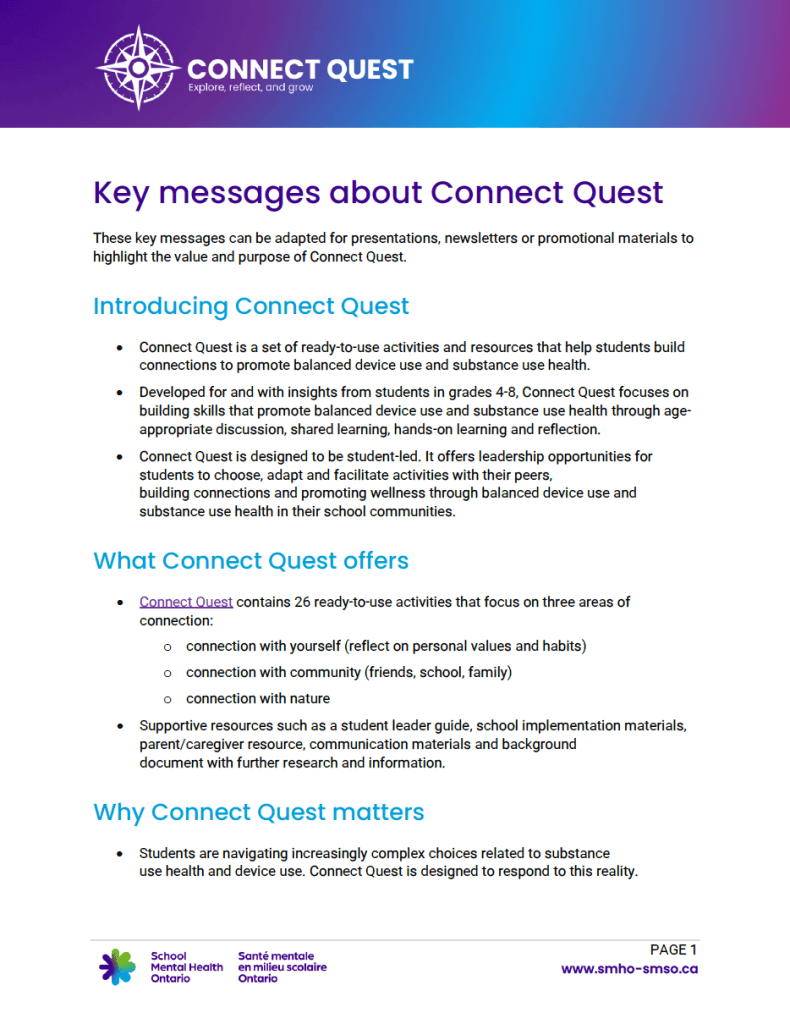
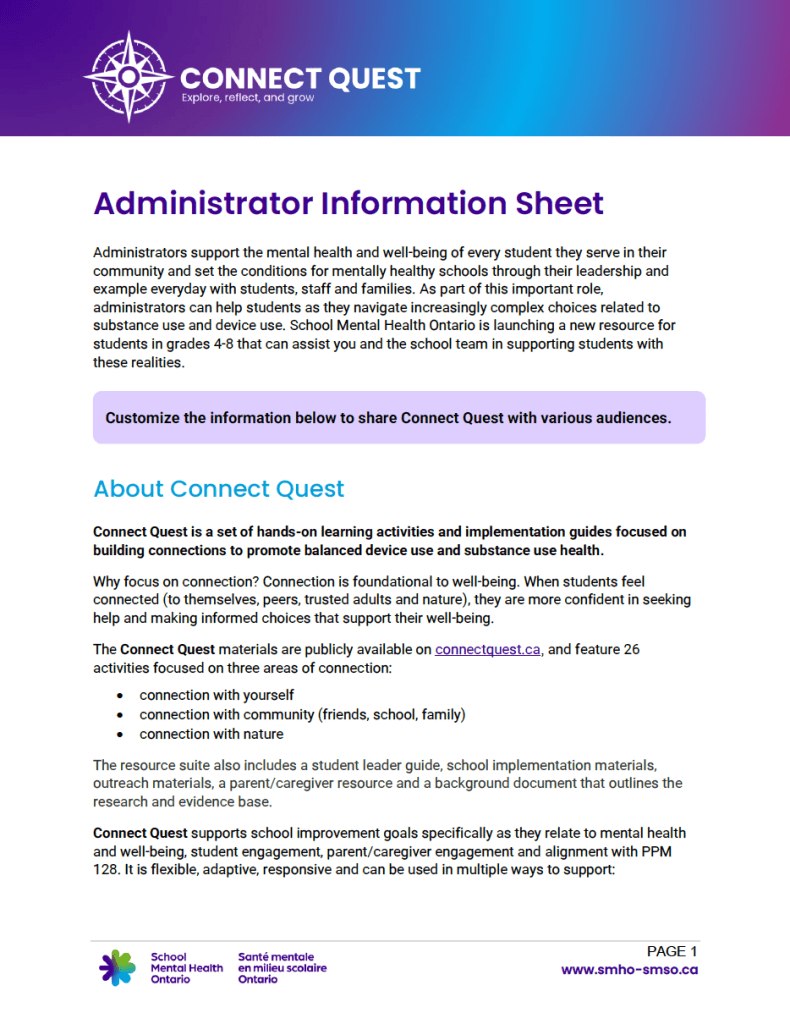
Connect Quest is a set of ready-to-use student-informed activities and supportive resources. It is designed to help students in grades 4–8 build connections that promote balanced device use and substance use health.
Why is Connect Quest important?
Connection supports well-being: Research shows that feeling connected, whether to peers, trusted adults or nature is a protective factor for mental health.
Support for healthy choices: Activities encourage balanced device habits and substance use health by building life skills such as coping, problem-solving and relationship-building.
Student-centered approach: The resource was developed with student input to help ensure relevance and engagement.
How to use Connect Quest
Individual student use: “Connect with yourself” activities can be done independently to reflect on emotions, build wellness habits, and work towards personal goals.
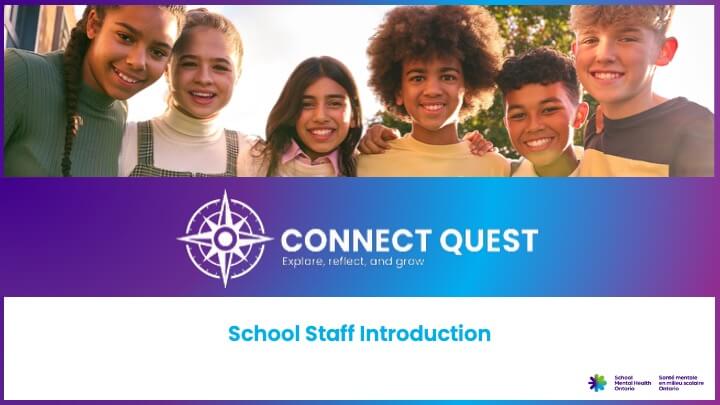
Classroom integration: Educators and student support staff can embed activities into lessons, group opportunities or clubs.
Student-led initiatives: Alongside caring adults at school, students can create a “Quest” or campaign where they choose, adapt and lead Connect Quest activities across their school to promote connection, balanced device use and substance use health. Quests can be carried out over several months, or over a short period of time (e.g., daily activities during Mental Health Week in May).
Family engagement: Parents and caregivers can use activities at home to support healthy routines and conversations about device use and substance use.
Implementation tools
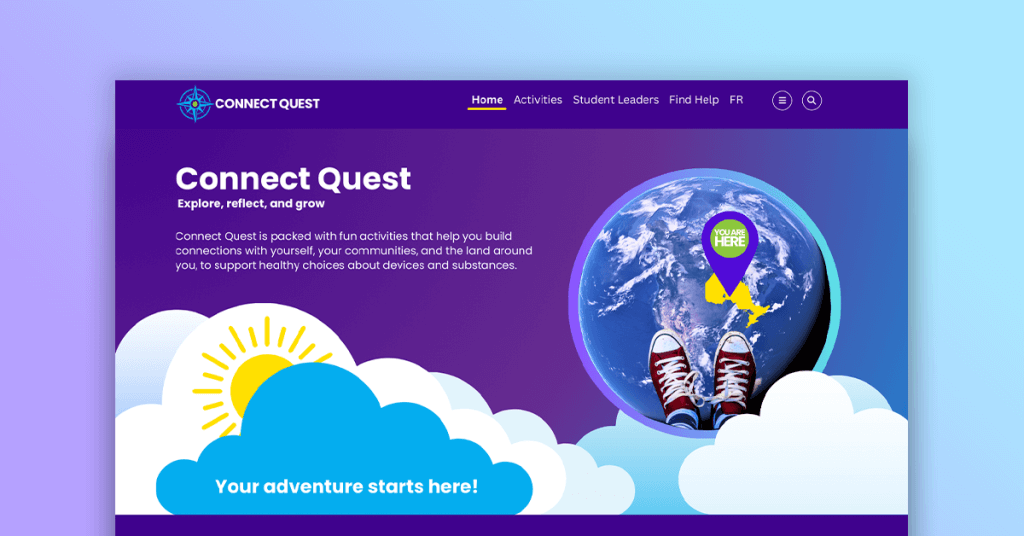
Connect Quest Website Tour – EN
0:09
Welcome to Connect Quest Connect Quest is a collection of ready to use activities and implementation guides designed to support the development of connections that promote balanced device use and substance use health.
0:22
The resources were developed with input from students in grades 4 to 8 through consultations across the province alongside a student working group.
0:32
Connect Quest can be used by students, school staff and families.
0:35
The resource focuses on skill building through age-appropriate discussion, shared learning, hands on activities and reflection.
0:43
Now let’s take a tour of our site.
0:47
At the top of the page, you’ll find a navigation bar which provides direct access to the activities, the Student Leader Guide and support resources.
0:57
Here you can also toggle between English and French or navigate to the sections that were designed to support our adult allies.
1:07
Next, let’s explore the Student Leader section.
1:12
Connect Quest is designed to support student leaders and their student groups to rally their school around the theme of connection.
1:19
The Student Leaders page begins with an introduction to Quest, the guide that supports students and adults throughout the site and activities.
1:28
This page includes a Getting Started section with key definitions and planning checklist to support the development of a student-led quest.
1:38
You’ll also find the Student Leader Guide which provides practical guidance for leading a quest.
1:44
Quests can be designed to run over a day, a week, a month, or the entire school year to support communication and engagement.
1:53
This section also includes sample announcements and other materials that can be used or adapted to share information about a Quest within your school community.
2:03
The Activities page is designed to make it easy for anyone to explore and use activities.
2:09
The activities are grouped into three categories.
2:13
Connect with yourself.
2:15
Activities in this category support personal reflection and self-awareness and can be completed individually or with others.
2:24
Connect with community.
2:26
These activities focus on strengthening connections with others such as peers, family, schools, and communities.
2:33
This section also includes shorter warm up activities that can be used within a quest or to support student leadership teams.
2:43
Connect with Nature. These activities encourage connection with the environment.
2:49
Each activity includes a summary, facilitation tips, the estimated time that it will take, the intended grade range, the level of adult support required, and a list of supplies.
3:03
“Quest” our guide, also explains how the activity supports balanced device use and substance use health.
3:09
3:11
Each activity also includes a downloadable PDF with step-by-step instructions and templates which allow the activity to be completed offline.
3:22
The Adult Allies section provides an overview of Connect Quest and includes links to both the Student Leader Guide and the activities.
3:29
Adult Allies are any adults who may be supporting the students to plan and lead their quests.
3:36
Further down the page you’ll find an Introduction and Background section.
3:41
This outlines how to use Connect Quest tools and has a downloadable PDF that provides a more detailed overview of the development and purpose of the resource.
3:53
This area also includes a School Implementation Guide which offers practical, ready to use guidance on getting started, facilitating activities and supporting implementation with confidence.
4:07
Not only does Connect Quest feature a flexible and student-centred design and multiple implementation options, but there’s also information specifically for parents and caregivers.
4:17
This includes an introduction to the terms balanced device use and substance use health, as well as a downloadable Parent and Caregiver Guide.
4:28
Thank you so much for taking this tour of Connect Quest.
4:31
We wish you success as you explore the activities and resources and support meaningful connections that promote balanced device use and substance use health.
Oberle, E., Ji, X. R., Kerai, S., Guhn, M., Schonert-Reichl, K. A., & Gadermann, A.M. (2020). Screen time and extracurricular activities as risk and protective factors for mental health in adolescence: A population-level study. Preventive Medicine, 141, 106291. https://doi.org/10.1016/j.ypmed.2020.106291
Public Health Agency of Canada. (2021). Blueprint for action: Preventing substance-related harms among youth through a comprehensive school health approach. https://www.canada.ca/en/public-health/services/publications/healthy-living/blueprint-for-action-preventing-substance-related-harms-youth-comprehensive-school-health.html
Public Health Agency of Canada. (2025). Young people in Canada: Focus on mental health (HBSC 2022–23). https://www.canada.ca/en/publichealth/services/publications/science-research-data/young-people-canada-focusmental-health.html
Public Health Agency of Canada. (2025). Outdoor physical activity, mental health, life satisfaction, and happiness among Canadian adolescents. https://www.canada.ca/en/public-health/services/reports-publications/healthpromotion-chronic-disease-prevention-canada-research-policy-practice/vol-45-no7-8-2025/outdoor-physical-activity-mental-health-life-satisfaction-happiness-lifestress-canadian-adolescents.html
Raniti, M., Rakesh, D., Patton, G. C., et al. (2022). The role of school connectedness in the prevention of youth depression and anxiety: A systematic review with youth consultation. BMC Public Health, 22(1), 2152. https://doi.org/10.1186/s12889-022-14364-6