
Connect Quest – student resource
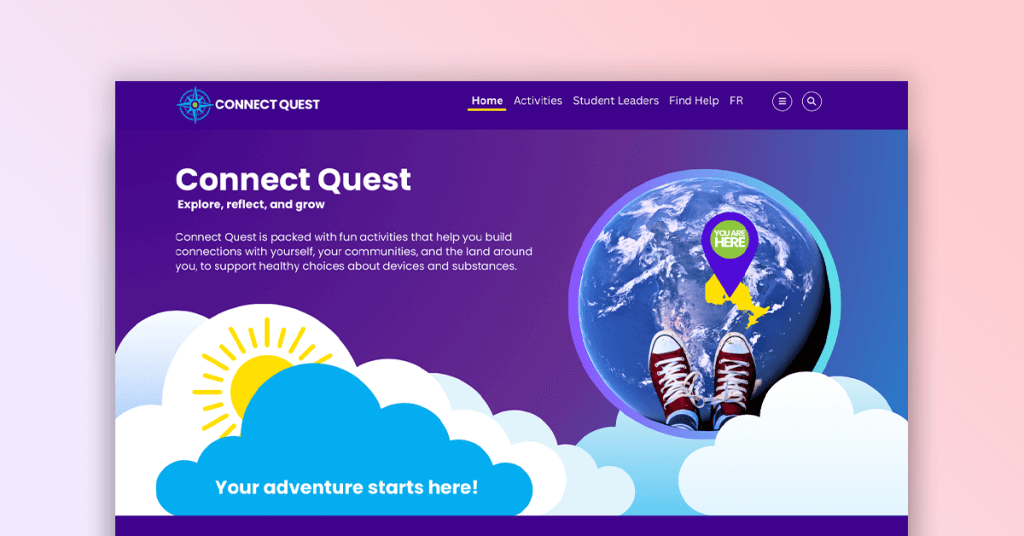
Connect Quest is filled with activities and resources you can use to build stronger connections with yourself, your friends, your school, your family and nature.
What is Connect Quest?
Connect Quest is a set of activities and resources made with and for students in grades 4-8. You can use it to build stronger connections with yourself, your friends, your school, your family and even nature.
Connection is a superpower. When you feel connected, it’s easier to:
- handle stress
- make healthy choices about devices and substances
- feel like you belong
You can try activities on your own, with your family, with a class or group or even lead a Quest at your school.
How can Connect Quest help you?
Connection supports your well-being
Feeling connected to yourself–your thoughts, feelings and values, and to people who care about you (like friends and family), your school community and nature can help protect your mental health.
Support for healthy choices
The activities in Connect Quest help students in grades 4-8 build real-life skills like coping, problem-solving and relationship-building. These skills can help you:
- find balance with devices and screen time
- make healthy choices about substances
- take care of your mental health
Built with students, for students
Connect Quest was shaped by Ontario student ideas and feedback through consultations and a student working group. That means it was made with you in mind.
How can you use Connect Quest?
On your own
Try “Connect with yourself” activities to:
- reflect on your feelings
- build healthy habits
- set personal goals
With your class
Your teachers and other school staff can use Connect Quest activities in lessons, clubs or group spaces to help everyone connect and learn together.
Want to make a bigger impact?
Work with a caring adult at your school to create your own Connect Quest. You and a group can choose activities, customize them and lead a Quest that helps your school build stronger connections and healthier habits. A Quest could:
- run over a few months
- happen during a special week (like Mental Health Week)
- include daily connection activities
At home
You can also explore activities with your family to start conversations about mental health and well-being, balanced device use, substance use health and building healthy routines together.
Oberle, E., Ji, X. R., Kerai, S., Guhn, M., Schonert-Reichl, K. A., & Gadermann, A.M. (2020). Screen time and extracurricular activities as risk and protective factors for mental health in adolescence: A population-level study. Preventive Medicine, 141, 106291. https://doi.org/10.1016/j.ypmed.2020.106291
Public Health Agency of Canada. (2021). Blueprint for action: Preventing substance-related harms among youth through a comprehensive school health approach. https://www.canada.ca/en/public-health/services/publications/healthy-living/blueprint-for-action-preventing-substance-related-harms-youth-comprehensive-school-health.html
Public Health Agency of Canada. (2025). Young people in Canada: Focus on mental health (HBSC 2022–23). https://www.canada.ca/en/publichealth/services/publications/science-research-data/young-people-canada-focusmental-health.html
Public Health Agency of Canada. (2025). Outdoor physical activity, mental health, life satisfaction, and happiness among Canadian adolescents. https://www.canada.ca/en/public-health/services/reports-publications/healthpromotion-chronic-disease-prevention-canada-research-policy-practice/vol-45-no7-8-2025/outdoor-physical-activity-mental-health-life-satisfaction-happiness-lifestress-canadian-adolescents.html
Raniti, M., Rakesh, D., Patton, G. C., et al. (2022). The role of school connectedness in the prevention of youth depression and anxiety: A systematic review with youth consultation. BMC Public Health, 22(1), 2152. https://doi.org/10.1186/s12889-022-14364-6