
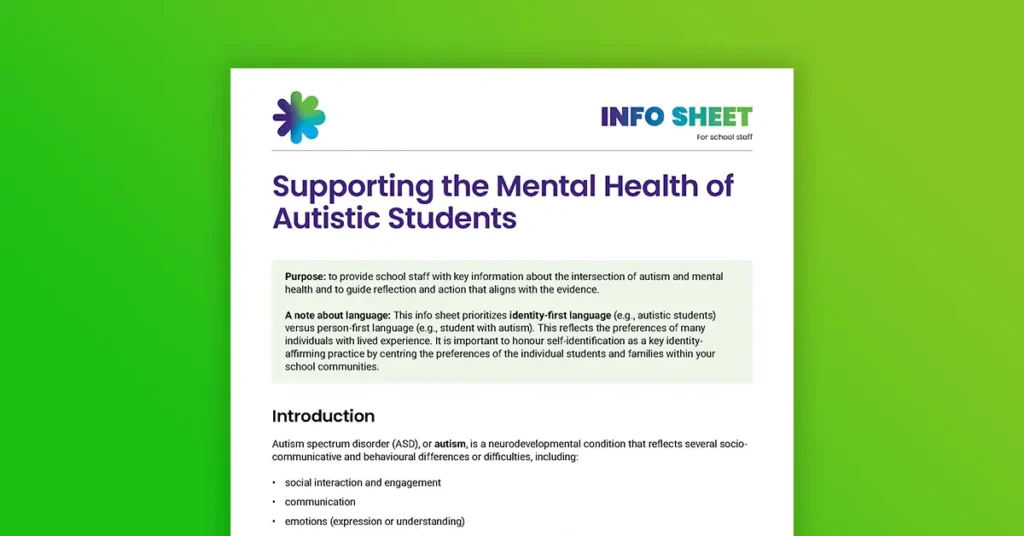
Supporting the Mental Health of Autistic Students
This resource for school staff offers key practices to support the well-being of autistic students at school.
Why is it important to understand the intersections of autism and mental health?
School staff can play a powerful role as they influence many of the factors associated with improved mental health and well-being for autistic students. Schools are vital in fostering conditions that promote well-being, early identification of emerging mental health concerns and coordination of supports.
How might I use this info sheet?
This info sheet can be used to support individual and group learning and reflection for school staff, as it highlights:
- factors associated with improved mental health and well-being for autistic students
- recommended practices across mental health promotion, learning and supports/services
- prompts to generate reflection and discussion
- additional tools and resources to go deeper
This info sheet is intended to be used alongside the Autism, Mental Health and the School Context evidence brief, building on the research by supporting reflection and guiding action for school staff.
A note about language
This info sheet prioritizes identity-first language (e.g., autistic students) versus person-first language (e.g., student with autism). This reflects the preferences of many individuals with lived experience. It is important to honour self-identification as a key identity-affirming practice by centring the preferences of the individual students and families within your school communities.
Adams, D. (2022). Child and parental mental health as correlates of school non-attendance and school refusal in children on the autism spectrum. Journal of Autism and Developmental Disorders, 52(8), 3353–3365. https://doi.org/10.1007/s10803-021-05211-5
Ali, D., Bougoure, M., Cooper, B., Quinton, A. M. G., Tan, D., Brett, J., et al. (2025). Burnout as experienced by autistic people: A systematic review. Clinical Psychology Review, 122, 102669. https://doi.org/10.1016/j.cpr.2025.102669
Alpuche DeLille, M. J., Teixeira da Silva, R., & Smythe, T. (2025). School-based mental health and psychosocial support interventions for children and adolescents with developmental disabilities in low- and middle-income countries: A systematic review. Tropical Medicine & International Health, 30(8), 763–781. https://onlinelibrary.wiley.com/doi/10.1111/tmi.70000
Andreasen, S., Kuntz, J., Ames, M. E., Coombs, E. C., & McMorris, C. (2024). Where are all the services: Mapping community-based services for Canadian autistic youth with co-occurring mental health conditions. Journal of Autism and Developmental Disorders. https://doi.org/10.1007/s10803-024-06681-z
Canadian Psychological Association. (2025). “Psychology Works” fact sheet: Autism spectrum disorder. https://cpa.ca/psychology-works-fact-sheet-autism-spectrum-disorder/
Carroll, A., Simpson, K., & Adams, D. (2026). Autistic children’s wellbeing at school: A systematic review. Review Journal of Autism and Developmental Disorders. https://doi.org/10.1007/s40489-026-00540-6
Cohen, S. R., Joseph, K., Levinson, S., Blacher, J., & Eisenhower, A. (2022). “My autism is my own”: Autistic identity and intersectionality in the school context. Autism in Adulthood, 4(4), 315–327. https://journals.sagepub.com/doi/10.1089/aut.2021.0087
Chapman, L., Rose, K., Hull, L., & Mandy, W. (2022). “I want to fit in… but I don’t want to change myself fundamentally”: A qualitative exploration of the relationship between masking and mental health for autistic teenagers. Research in Autism Spectrum Disorders, 99, 102069. https://doi.org/10.1016/j.rasd.2022.102069
Cromwell, C. (2026, May 6). Discussions on critical, humanizing, and identity-affirming practice.
Fontil, L., & Petrakos, H. H. (2015). Transition to school: The experiences of Canadian and immigrant families of children with autism spectrum disorders. Psychology in the Schools, 52(8), 773–788. https://onlinelibrary.wiley.com/doi/10.1002/pits.21859
Gallant, C., Maddox, B. B., & Weiss, J. A. (2024). The mental health needs of autistic youth in remote areas of Ontario, Canada: Clinicians’ perspectives. Journal of Rural Mental Health, 48(2), 97–108. https://doi.org/10.1037/rmh0000246
Gerlach, A. J., Matthiesen, A., Moola, F. J., & Watts, J. (2022). Autism and autism services with Indigenous families and children in the settler-colonial context of Canada: A critical scoping review. Canadian Journal of Disability Studies, 11(2), 1–39. https://doi.org/10.15353/cjds.v11i2.886
Government of Ontario. (n.d.). Support for students with autism. https://www.ontario.ca/page/support-students-autism
Hasson, L., Keville, S., Gallagher, J., Onagbesan, D., & Ludlow, A. K. (2024). Inclusivity in education for autism spectrum disorders: Experiences of support from the perspective of parent/carers, school teaching staff and young people on the autism spectrum. International Journal of Developmental Disabilities, 70(2), 201–212. https://www.tandfonline.com/doi/full/10.1080/20473869.2022.2070418
Kannabiran, M., & McCarthy, J. (2009). The mental health needs of people with autism spectrum disorders. Psychiatry, 8(10), 398–401. https://doi.org/10.1016/j.mppsy.2009.06.016
Kelley, E., & Roncadin, C. (2026). Understanding and supporting autistic children’s mental health. McMaster Children’s Hospital. https://www.youtube.com/watch?v=kjYDjnmk6mo
Lai, M. C., Kassee, C., Besney, R., Bonato, S., Hull, L., Mandy, W., et al. (2019). Prevalence of co-occurring mental health diagnoses in the autism population: A systematic review and meta-analysis. The Lancet Psychiatry, 6(10), 819–829. https://doi.org/10.1016/S2215-0366(19)30289-5
Mallipeddi, N. V., & VanDaalen, R. A. (2022). Intersectionality within critical autism studies: A narrative review. Autism in Adulthood, 4(4), 281–289. https://journals.sagepub.com/doi/10.1089/aut.2021.0014
McMorris, C. A., Baraskewich, J., Ames, M. A., Shaikh, K. T., Ncube, B. L., & Bebko, J. M. (2019). Mental health issues in post-secondary students with autism spectrum disorder: Experiences in accessing services. International Journal of Mental Health and Addiction, 17(3), 585–595. https://doi.org/10.1007/s11469-018-9988-3
Pickard, K., Maddox, B. B., Boles, R., & Reaven, J. (2024). A cluster randomized controlled trial comparing the effectiveness of two school-based interventions for autistic youth with anxiety. BMC Psychiatry, 24, 6. https://doi.org/10.1186/s12888-023-05441-0
Public Health Agency of Canada. (2025). Understanding autism data in the Canadian Chronic Disease Surveillance System. https://health-infobase.canada.ca/src/doc/autism-blog/Understanding-autism-data.pdf
Roberts, J., & Webster, A. (2022). Including students with autism in schools: A whole school approach to improve outcomes for students with autism. International Journal of Inclusive Education, 26(7), 701–718. https://www.tandfonline.com/doi/full/10.1080/13603116.2020.1712622
Sturm, A., & Kasari, C. (2023). School-based mental health interventions for autistic youth: Current practice and promising future directions. In S. W. Evans, J. S. Owens, C. P. Bradshaw, & M. D. Weist (Eds.), Handbook of School Mental Health: Innovations in Science and Practice (pp. 121–141). Springer International Publishing. https://doi.org/10.1007/978-3-031-20006-9_9
Taboas, A., Doepke, K., & Zimmerman, C. (2023). Preferences for identity-first versus person-first language in a US sample of autism stakeholders. Autism, 27(2), 565–570. https://journals.sagepub.com/doi/10.1177/13623613221130845
Weiss, J. (2026). Supporting students with autism and mental health challenges. School Mental Health Ontario.