
Research and Evaluation
Research in school mental health helps us better understand what students need to feel well, connected, and supported at school, while identifying the programs, practices, and approaches that have the greatest impact on their well-being and success.
By combining student voice, lived experiences, evidence-informed research, and knowledge from the field of implementation science, we can make better decisions, strengthen implementation, and ensure that mental health supports are effective, equitable, and responsive to the diverse needs of every student. A focus on implementation also helps us understand how successful approaches can be scaled across different school contexts and sustained overtime, maximizing long-term impact and reach.
What We Do
School Mental Health Ontario (SMH-ON) supports the advancement of evidence-informed school mental health across Ontario through research, program evaluation, implementation monitoring and knowledge mobilization. Working at the intersection of research, policy and practice, we collaborate with school boards, provincial partners, researchers, educators, students, families and mental health professionals to strengthen the quality, effectiveness, and sustainability of school mental health initiatives.
Our work includes:
- Conducting school mental health research and environmental scans
- Evaluating mental health programs, services, training and implementation efforts
- Monitoring system and provincial outcomes
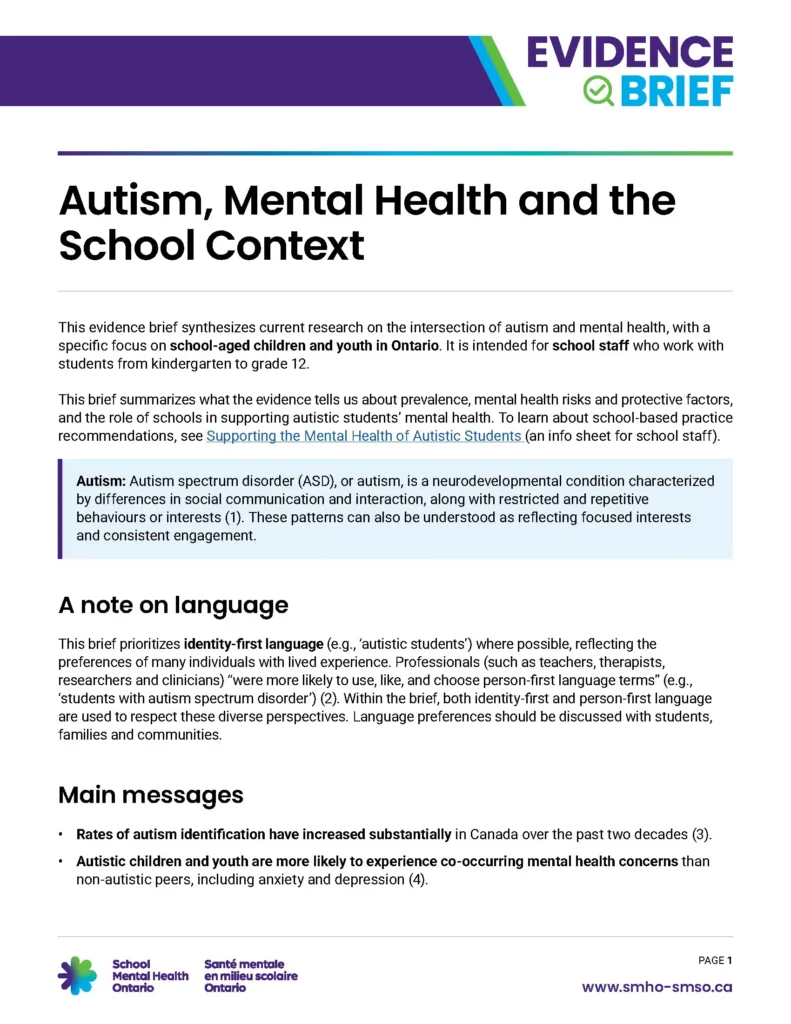
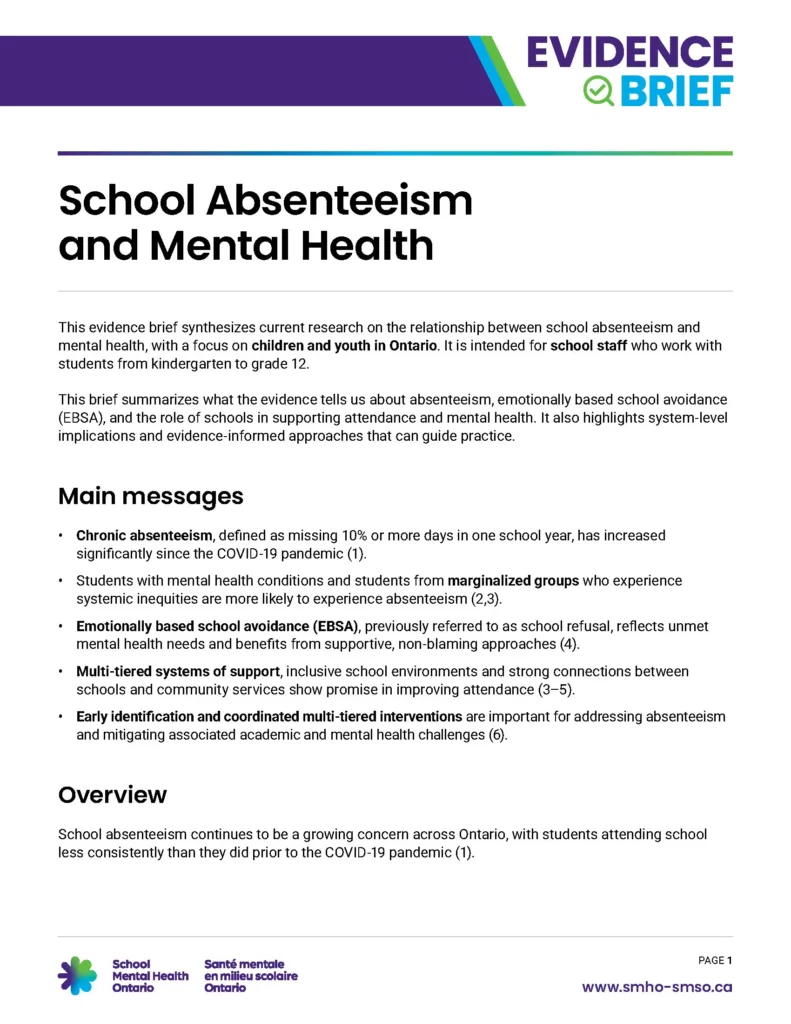
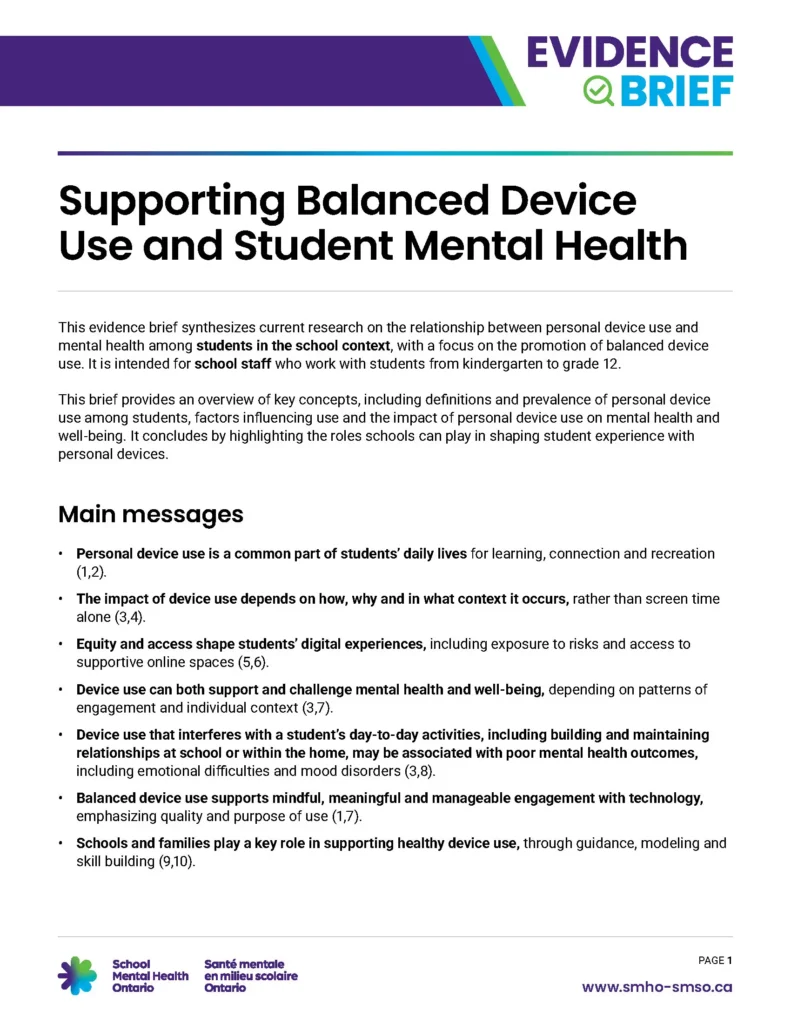
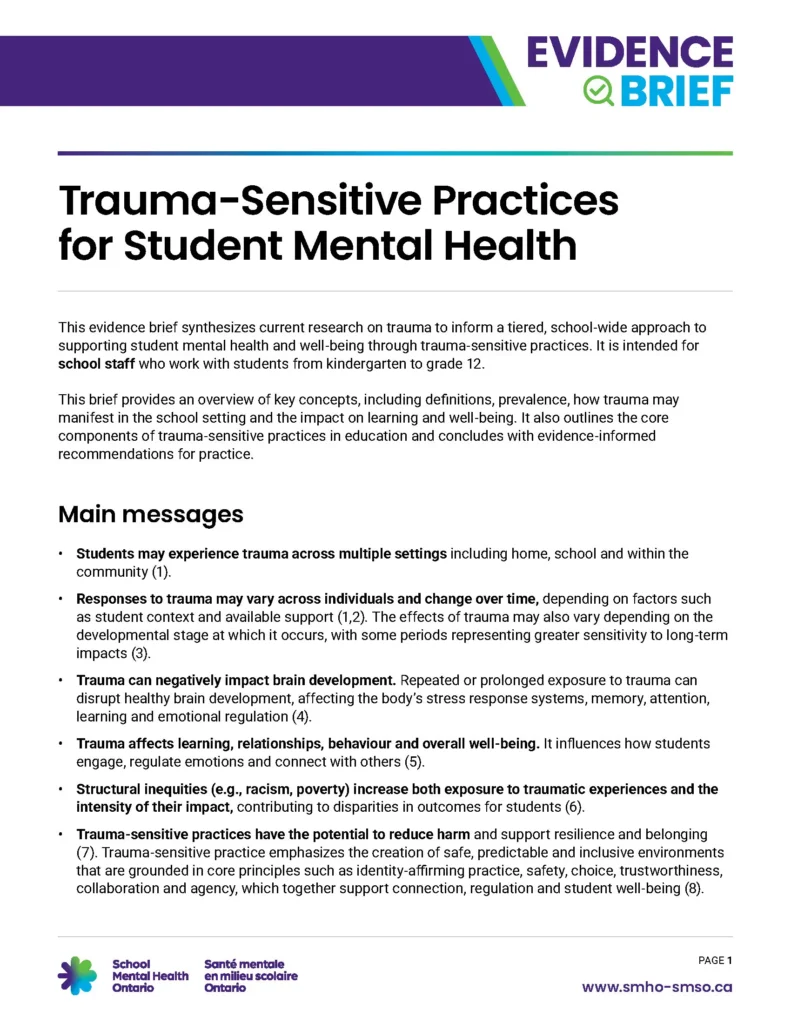
- Generating and sharing evidence briefs and reports related to student mental health
- Supporting mental health program innovation through the Innovation and Scale-Up lab
- Supporting school boards with mental health research, evaluation, and data monitoring needs
- Translating evidence into practical tools, resources, and services for educators and school mental health professionals
Why This Is Important
SMH-ON generates and applies evidence to support decision-making at all levels of the education system.
Through rigorous evaluation, data collection, implementation science, and continuous quality improvement processes, we examine how our professional learning is experienced, how school mental health programs and services are delivered, and how mental health supports are reaching students, families, school and system-level educators, student support staff, school mental health professionals and other board staff.
Findings are used to inform resource development, professional learning, strategic planning, and system-level improvement efforts in publicly funded school boards across Ontario.
Research Across the Continuum
School mental health in Ontario is guided by the Aligned and Integrated Model (AIM) and a Multi-Tiered System of Support. Together, these frameworks help school boards organize and coordinate mental health promotion, prevention, early intervention, and pathways to specialized or more intensive services.
Our research and evaluation work examines mental health implementation across all three tiers of support.
Tier 1: Mental Health Promotion and Literacy
Universal supports that create the conditions for all students to thrive. This includes mentally healthy environments, mental health literacy, social-emotional learning, belonging, inclusion, and positive relationships across the school community. SMH-ON evaluates our training and resources as well as the reach of our foundational resources.
Tier 2: Prevention and Early Intervention
Targeted supports for students who may be experiencing emerging mental health concerns or increased vulnerability. Research and evaluation activities focus on curating evidence-based prevention programming and approaches from the global literature, understanding the effectiveness of our training and resources and field-testing and scaling evidence-informed interventions.
Tier 3: Intervention and Specialized Support Pathways
Intensive and coordinated supports for students requiring more complex mental health services. SMH-ON partners with community organizations with expertise in specialized areas to provide training and support to board level teams, in keeping with the Right Time, Right Care principles and vision. In addition, we provide guidance related to school-based stabilization and supportive techniques that can be used while students with significant mental health needs are waiting for, or advancing to, from, and through treatment. We evaluate the effectiveness of our training, programming, and service pathways.
Our Impact
Through research, evaluation and ongoing monitoring, we contribute to a stronger understanding of what works in school mental health and help to drive continuous improvement across Ontario’s education system. By building and sharing evidence we support a comprehensive, equitable, and responsive approach to school mental health that promotes the well-being, resilience, and success of every student.
Innovation and Scale up Lab
The following programming is currently being studied for fit and feasibility:
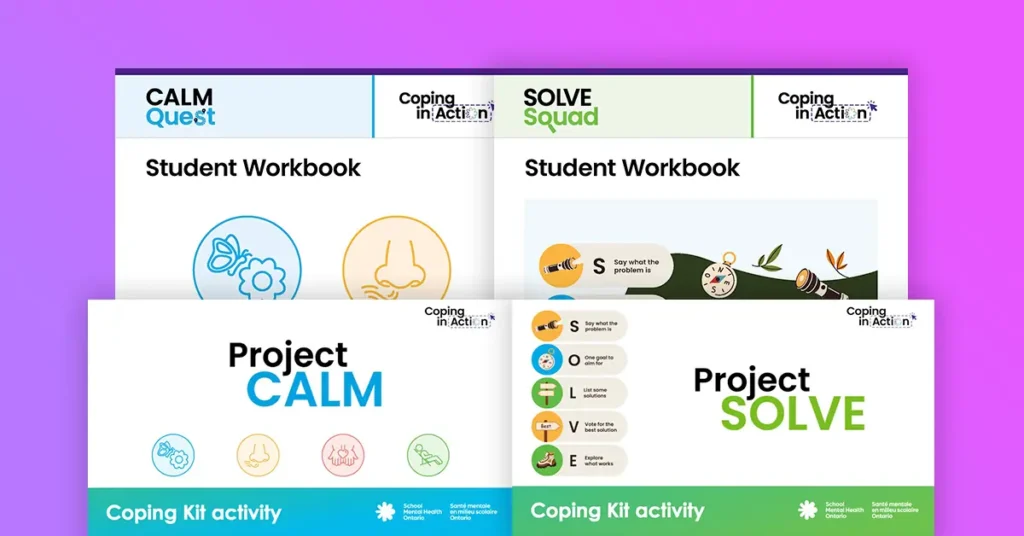
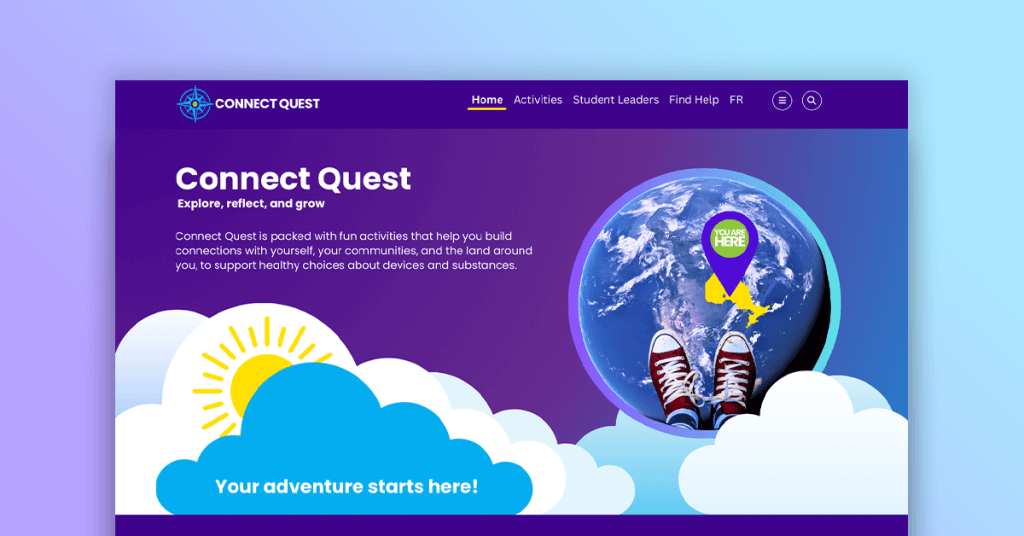

Projects at tier 1 – Universal mental health promotion
Everyday Mental Health
The Everyday Mental Health project includes a series of classroom resources designed to support educators by offering a selection of high-quality everyday mental health practices that can be easily applied into daily classroom routines.
Resources include:
- Everyday Mental Health Classroom Resource
- Faith and Wellness – A Daily Mental Health Resource
- Everyday Mental Health for Secondary School Classrooms
Partners
- ETFO/FEÉO – Elementary Teachers’ Federation of Ontario/Fédération des enseignantes et enseignants de l’élémentaire de l’Ontario
- OECTA – Ontario English Catholic Teachers’ Association
- OSSTF/FEÉSO – Ontario Secondary School Teachers’ Federation/Fédération des enseignantes-enseignants des écoles secondaires de l’Ontario
- AEFO – Association des enseignantes et enseignants franco-ontariens
Research collaborators
- Brock University
- CAMH – Centre for Addictions and Mental Health


Skills4Life Career Studies SEL (S4L/H2V)
Skills for Life is an 8-lesson resource that was developed to be integrated into the Grade 10 Ontario Career Studies curriculum. It is informed by scientific research, co-written by Ontario educators and school mental health professionals, and designed to support students’ success in their chosen career pathway. This resource aims to teach students about skills for resiliency, caring for their mental health, noticing signs of difficulty, and to effectively seek out help when in need.
Partners
- OSSTF/FEÉSO – Ontario Secondary School Teachers’ Federation/Fédération des enseignantes-enseignants des écoles secondaires de l’Ontario
Research collaborators
- SRDC/SRSA – Social Research and Demonstration Corporation/Société de recherche sociale appliquée
S4L Outcome Evaluation Results


Projects at tier 2 – Prevention and early intervention
Brief Intervention for School Clinicians (BRISC)
The Brief Intervention for School Clinicians (BRISC) is a tier two, assessment, engagement, brief intervention (4 sessions), and triage strategy that is well suited to respond to the need of students with mild to moderate mental health problems.
This intervention was co-developed by the SMART Center faculty at the University of Washington, school leaders and school mental health providers in order to actively address known issues faced by School mental health (SMH) providers. These include, carrying large caseloads, experiencing significant time constraints, and needing to serve youth with a broad array of needs. Therefore, BRISC aims to be brief, evidence-based, flexible and to fit the school context.
Partners
- University of Washington
Research collaborators
- School Mental Health Assessment Research and Training (SMART) Center

Supporting Transition Resilience of Newcomer Groups (STRONG/FORT)
The welcoming of large numbers of refugees over the past few years is a point of national pride for most Canadians. However, the majority of these newcomer families experienced significant trauma before arriving to Canada. Thousands of children in these families are now in Canadian schools, and many continue to struggle with symptoms of distress and trauma. The Centre for School Mental Health (CSMH), partnered on a new initiative led by School Mental Health Ontario to bring appropriate school-based services to these children and youth.
The STRONG program (Supporting Transition Resilience of Newcomer Groups) is a 10-week, school-based intervention developed by experts from the National Center for School Mental Health in Maryland and their colleagues at the Center for Childhood Resilience in Chicago. The program was initially piloted in spring 2018 in two Ontario school boards and has broadened its scope since then, extending to 9 school boards in the province, including two French-language school boards. The ongoing evaluation of the intervention focuses on feasibility, implementation, and preliminary student impact.
Partners
- National Center for School Mental Health (University of Maryland)
Research collaborators
- Centre for School Mental Health (Western University)

Evidence Briefs
Contact us
Please reach out to rem@smho.smso.ca for further information or if you have any questions.