
Understanding mental health
Mental health and mental illnesses are related, but they aren’t the same things, and understanding this difference is important.
What is mental health?
The World Health Organization defines mental health as a positive state of wellness and flourishing that allows you to feel, think and act in ways that help you enjoy life and cope with its challenges.
For children and youth, good mental health:
- supports learning and engagement
- strengthens social connection and belonging
- builds resilience and coping skills
When students experience good mental health, they are more ready to learn, feel a stronger sense of belonging at school and perform better academically.
Many perspectives help us understand mental health and well-being. For example, the First Nations Mental Wellness Continuum Framework describes wellness as “a balance of the mental, physical, spiritual, and emotional” aspects of life. This holistic view reminds us that everyone, including those experiencing mental illness or vulnerability, holds the strength and capacity to live in balance and wholeness. Increasingly, across models for understanding mental health, there is a focus on flourishing and wellness, recognizing that mental health is more than the absence of mental illness. Like physical health, it is something we all have and need to care for over time.
What are mental illnesses?
Mental illnesses are conditions that affect mood, thinking or behaviour and can significantly interfere with daily life over time. Examples of mental illnesses include mood disorders, anxiety disorders, schizophrenia, eating disorders and substance use disorders.
The brain plays an important role in our thoughts, emotions and behaviours, which is why mental illnesses are often thought of as being a disease of the brain. While this is partly true, mental illnesses are also influenced by a range of factors and experiences, including:
- genetics
- social conditions (often referred to as social determinants of health), (e.g., income and social status, physical environments, race and racism, access to health services)
- experiences of trauma or chronic stress
It’s good to remember that even when we, or our students, are experiencing more serious mental health concerns, recovery and wellness are possible.
Why this is important in schools
Schools are everyday places of learning, relationships and belonging. Because of this, they play a critical role in supporting mental health for all students.
When schools:
- promote positive mental health,
- notice early signs of distress, and
- provide timely, culturally responsive supports
students are more likely to feel connected, engaged and ready to learn.
What the research tells us
Some forms of mental illness are rare (e.g., one percent of the Canadian population suffers from schizophrenia). Other types of mental health disorders are more common. Overall,18% of Canadians over 15 years of age met the diagnostic criteria for a mood, anxiety or substance use disorder in the previous 12 months.
Data related to children and youth indicates:
- Approximately 70% of mental health and addiction issues begin in childhood and adolescence.
- 18-22% of students in Ontario, or approximately one in five students aged four to 17, meet the criteria for a mental illness.
- The most common forms of mental health problems for children and youth relate to disorders of:
- attention
- anxiety
- mood
- behaviour
- Early identification and early intervention helps to improve outcomes for young people.
- Schools have been identified as a key setting for mental health promotion, early identification, prevention and early intervention services, and are the first place many young people go for mental health go for mental health support.
For more information, see Student mental health at a glance.
What is the difference between distress and a disorder?
Everyone experiences ups and downs. Stress, sadness, worry or changes in behaviour can be part of typical development – especially during adolescence. Because of this, it can be challenging to determine if changes you observe are simply a typical reaction or normal fluctuation, or if it’s something more serious requiring treatment. For younger children, mental health concerns can often go undiagnosed because children don’t always express their feelings and thoughts in a way that signals a mental health problem.
A helpful rule of thumb is to pay attention when changes:
- last more than two weeks,
- cause distress, and
- negatively impact day-to-day life.
When this happens, it’s a sign that additional support may be needed.
Understanding the relationship between mental health and mental illness
Mental health is more than the absence of mental illnesses. It is a positive state of wellness and flourishing. Note that even when experiencing a mental illness, it’s possible to feel mentally well. It’s also possible to have problems with mental health and not have a mental illness. The dual continuum model helps explain the relationship between mental health and mental illness, as two separate but interconnected concepts.
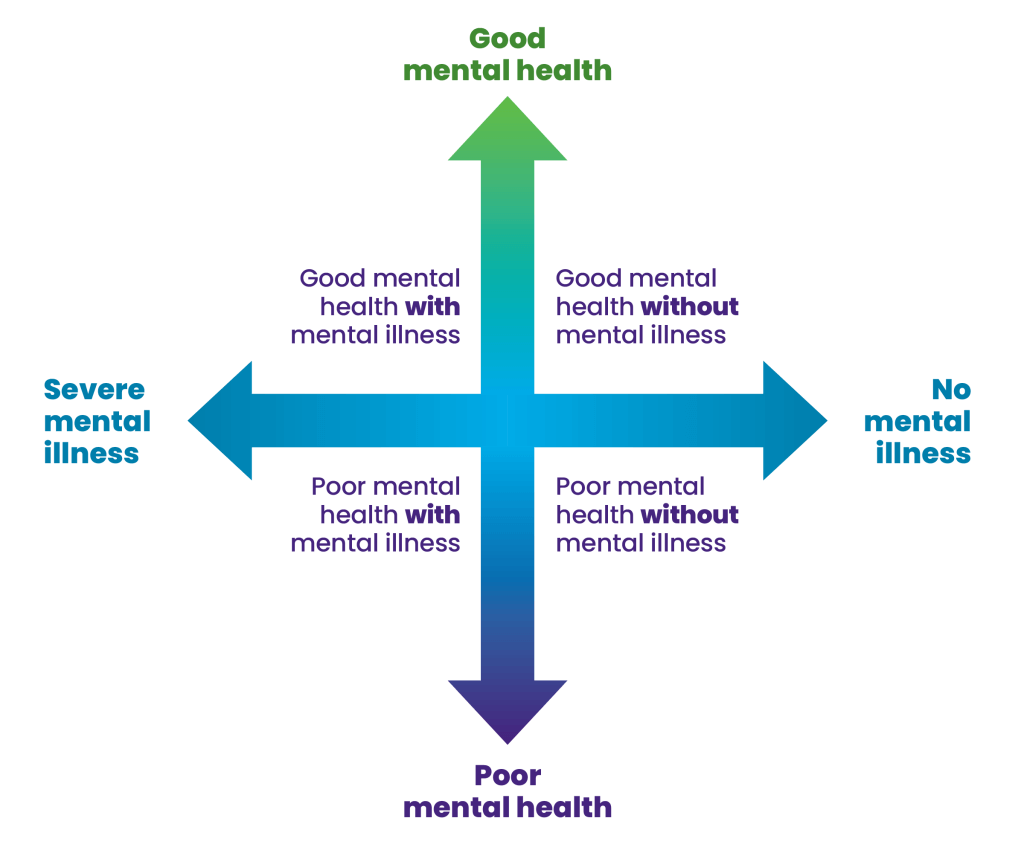
This graphic is a visual representation of the dual continuum model of mental health. The graphic is divided into four quadrants with a two-sided arrow running through the middle both vertically and horizontally. The arrows represent a continuum on both axes. The north south axis is labelled “good mental health” on the top and “poor mental health” on the bottom. The east west axis is labelled “no mental illness” on the right and “severe mental illness” on the left. The upper right quadrant reads “good mental health without mental illness”. Moving clockwise from here the lower right quadrant reads “poor mental health without mental illness. The bottom left quadrant reads “poor mental health with mental illness”. The upper left quadrant reads “good mental health with mental illness
On the horizontal arm of the dual continuum, an individual may find themselves somewhere along the line between experiencing ‘no mental illness’ and struggling with ‘severe mental illness.’ Note that positioning can change over time, with treatment or with changes in life circumstances. At the same time, along the vertical arm of the continuum, an individual may be in a state of good or poor mental health, or anywhere in between.
Again, this sense of well-being can change over time and is not static. The implication is that:
- A person can have a mental illness and still experience positive mental health.
- A person can have no mental illness but still experience poor mental health.
In schools, this understanding reinforces why mental health promotion and literacy are beneficial for every student, not just those experiencing illness. Everyday practices can strengthen well-being wherever a student may be on the continuum.
This short video from the Centre for Addiction and Mental Health (CAMH) describes the dual continuum model in more detail: