
Understanding substance use health
Substance use health
Substance use health is part of overall health and well-being. It recognizes that substance use exists on a spectrum and that people’s experiences with substances can change over time.
Rather than focusing only on illness or abstinence, substance use health looks at both potential benefits and risks, and supports informed, compassionate, and evidence-based responses.
What is substance use health?
Substance use health describes the full range of ways people may interact with substances, from no use to lower-risk use, to higher-risk use, and, for some, substance use disorders.
This approach:
- recognizes that some substances may be used in health-promoting ways (for example, medicinally or ceremonially)
- acknowledges that substance use can also carry risks and negative impacts
- emphasizes understanding, prevention and support rather than judgement.
CAPSA offers this visual to show the spectrum of substance use health, from no use, through lower use, higher use, declining health and substance use disorder. Everyone has a place on the Substance Use Health Spectrum, and that place can shift over time depending on life circumstances, stress, supports and environment:
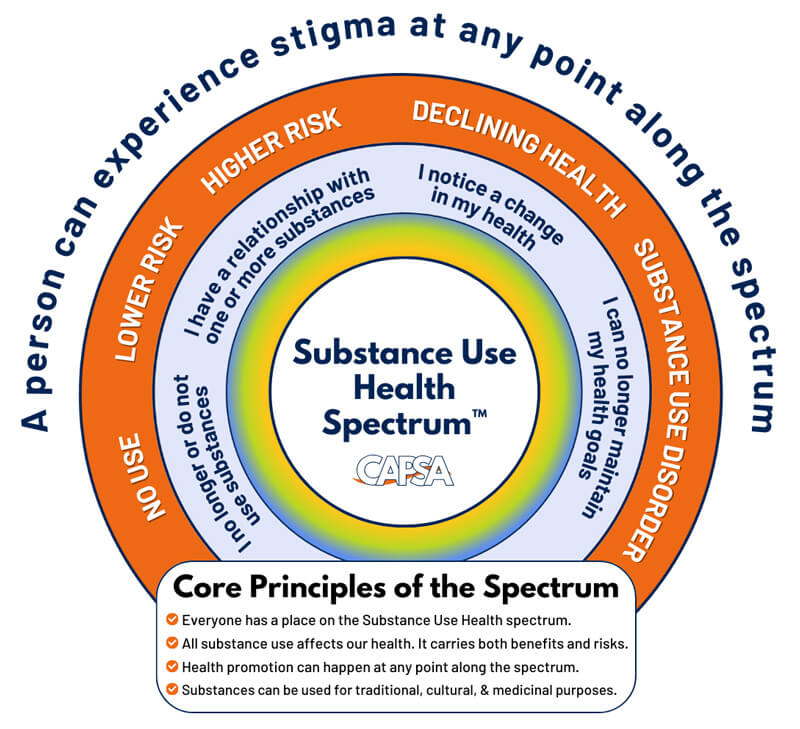
The image is a circular infographic titled “Substance Use Health Spectrum.” It shows substance use as a range, that everyone has a place on the spectrum, and that that place can shift over time.
At the centre is a small circle labelled “Substance Use Health Spectrum (CAPSA).” Surrounding it are several coloured rings that move outward, showing different experiences along the spectrum.
The inner ring represents the relationship with substances, with labels “I no longer or do not use substances, I have a relationship with one or more substances, I notice a change in my health, I can no longer maintain my health goals.” Moving outward, the colours shift and the labels describe levels of risk, including: “No use, lower risk, higher risk, declining health, substance use disorder.”
Along the top of the image, curved text reads: “A person can experience stigma at any point along the spectrum.” This emphasizes that stigma can affect people regardless of where they fall on the spectrum.
At the bottom of the image is a section titled “Core Principles of the Spectrum.”
These principles highlight that:
- Everyone has a place on the Substance Use Health spectrum.
- All substance use affects our health. It carries benefits and risks.
- Health promotion can happen at any point along the spectrum.
- Substances can be used for traditional, cultural and medical purposes.
The overall design uses a gradient of colours, from cooler tones to warmer tones, to visually represent movement from lower risk to higher risk, reinforcing that substance use is not fixed or binary.
Why this is important in schools
Substance use health is closely connected to learning, well-being and belonging. Schools are important settings for:
- building knowledge and skills that help students make informed choices
- reducing stigma and misinformation
- noticing early signs of concern with substances and responding with support
- connecting students and families to appropriate help when needed
Approaching substance use through a health lens, rather than focusing on fear or punishment, supports more effective prevention and early intervention.
What are substance use disorders and addictions?
Substance use disorder involves continued and compulsive use of substances such as alcohol, nicotine, cannabis or other drugs, despite negative impacts on a person’s life, relationships or well-being. There are other potential effects associated with the use of substances that heighten addictive patterns, including:
- increased tolerance
- dependence
- withdrawal symptoms when use stops
Addiction can also extend beyond the use of substances to compulsive and continuous behaviours related to things like Internet use, gaming, gambling, shopping and exercise. When patterns of addictive behaviour escalate, there can be serious risks. For example, among young adults aged 18 to 29, risks associated with online gambling are significant, with as many as 23% of those who participated in this activity in the past year experiencing debt, reduction in savings and compromised mental health.
Substance use disorders and addictions are often misunderstood and highly stigmatized. Using clear, accurate language helps reduce stigma and supports compassionate responses for young people who may be struggling.
What the research tells us
- Mental health and substance use health are closely linked.
- People with a mental illness are twice as likely to have a substance use disorder compared to the general population.
- People with substance use disorders are up to three times more likely to experience a mental illness.
- Young people aged 15 to 24 experience higher rates of mental health and substance use disorders than any other age group.
Given this relationship, it is important to build mental health literacy and substance use health knowledge together to help young people to make healthy and informed choices.